

I was scrolling on YouTube today and got a notification about a new video from DesFit. It was his long-term review of the Garmin Forerunner 970 after using it for a full year. If you know anything about sports watches, you know DesFit is one of the most famous and trusted reviewers when it comes to Garmin gear. I immediately clicked to see what he had to say.
Even though the watch came out over a year ago, DesFit realized he never actually did a full, in-depth review of it. Funny enough, he said the watch has barely left his wrist. Instead of just listing specs, he explained exactly how the watch fits into his daily training and why it often beats out heavier, more expensive options.
Here is what I learned from his video about what it is really like to live with the Forerunner 970 for a year.
Comfort Wins the Daily Battle
For a long time, DesFit used larger, heavier watches as his daily wear. Switching to the Forerunner 970 was a breath of fresh air for him. He really loves how thin and lightweight the watch is, making it super comfortable to wear all day and even during sleep.
He points out that the Garmin Fenix series definitely looks more premium and has a tough metal build, but it comes with a lot of extra bulk. For his wrist size, the 970 is the perfect middle ground. His only real complaint about the design is that Garmin doesn’t make a smaller version for people with slender wrists.
The Killer Feature: A Built-In Flashlight
If there is one hardware feature that made DesFit fall in love with this watch, it is the built-in LED flashlight.
“It’s one of those features that once you have it, it’s kind of hard to imagine life without it,” he says in the video.
Interestingly, he rarely uses it for workouts. Instead, it has become an essential everyday tool. Whether he is walking around the house in the middle of the night without waking his family, looking for things under the couch, or searching the back of a dark pantry, the flashlight gets used every single day.
Battery Life and Screen Settings
DesFit gets about 5 to 6 days of battery life out of the bright AMOLED screen. Here is how he sets up his watch to get that result:
-
Always-On Display (AOD): Turned on for both workouts and daily wear.
-
Screen Timeout: Set to 8 seconds.
-
Brightness: Set to the lowest level for daily use.
-
Pulse Ox (Blood Oxygen): Only tracks throughout the night.
He notes that Garmin’s latest screens are crazy bright outdoors, so the lowest setting is perfectly fine for indoors. He does wish Garmin would give users more brightness choices, though. He thinks it is weird that the watch only has three brightness levels during the day, but gives you four options when you are in night focus mode.
Health Tracking and Sleep Quirks
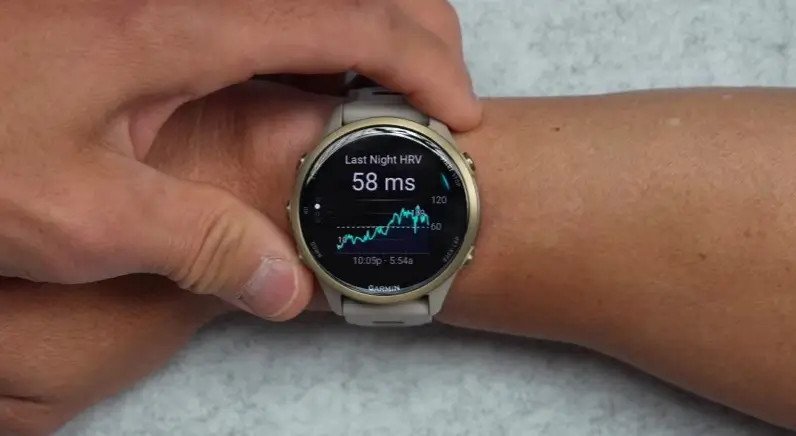
The Forerunner 970 comes with every health feature Garmin has to offer. DesFit mostly looks at his heart rate variability (HRV), sleep data, and Garmin’s new “health status” feature, which works like Apple’s Vitals app to show you if your body stats are dropping before you get sick.
However, sleep tracking hasn’t been completely perfect. While it usually works well, DesFit says it sometimes misses the times he wakes up in the night. Over the past year, the watch completely failed to record his sleep on three or four random nights.
He also noticed a funny quirk with naps: the watch often misses actual naps on the couch, but almost always records a nap when he gets a massage because his heart rate drops so low.
Performance and Sports Tracking
When hitting the gym, DesFit keeps things simple. He pins cycling, running, and a general cardio profile to his top menu. He uses the basic cardio profile for weight training and high-intensity interval training (HIIT), skipping the dedicated strength profile unless he is actively testing something.
On the software side, he highlights a few features:
-
Training Readiness: He loves this feature. It helps him see how well his body is recovering. He used to get the dreaded “unproductive” status a lot from overtraining, but lately, he has kept it “productive” by doing true Zone 2 easy days and taking more rest.
-
Running Economy and Step Speed Loss: These new metrics help measure how efficient your running form is. DesFit likes them, but he reminds viewers that you need Garmin’s premium (and expensive) HRM-Pro Plus heart rate strap for these metrics to work.
-
GPS and Altimeter: GPS accuracy via Garmin’s “Auto Select” mode has been flawless, switching satellite modes automatically based on tree cover. The altimeter was mostly accurate, but sweat or moisture caused it to give a few weird elevation readings on a handful of bike rides.
Heart Rate Accuracy on the Wrist
Because DesFit continuously tests other wearables, he almost always wears a chest strap to get perfect data. But for people who hate chest straps, he shared how well the watch’s wrist sensor performed:
-
Indoor Cycling: Near perfect, matching the chest strap almost exactly.
-
Road and Gravel Cycling: Highly accurate, though it lagged a little bit when catching his heart rate dropping during quick rest stops.
-
Running: Generally very good, with only minor blips where the sensor briefly confused his heart rate with his running cadence (steps per minute).
-
Weight Training: It tracked general trends fine, but DesFit notes that the Apple Watch and Google Pixel Watch still handle quick heart rate spikes during weight lifting a bit better.
Why Choose the 970 Over a Fenix 8?
The Forerunner 970 has almost all the same internal features as the premium Fenix 8, except for recreational scuba diving and an LTE option. For DesFit, the choice comes down to what he actually needs. The 970 gives him all the data he can handle, includes the essential flashlight, and is simply lighter and more comfortable on his wrist.
The Price Problem
If there is one major downside, it is the price tag. The Forerunner 970 costs $750, which is a $150 increase over the older Forerunner 965.
While DesFit believes the addition of the flashlight and a sapphire lens helps explain the cost, he feels $650 to $700 would be a much better price point. Because the older premium Fenix 8 now frequently goes on sale for around $849, it puts the $750 Forerunner 970 in a tough position for buyers trying to choose between ultimate durability and lightweight comfort.
Still, after a full year of testing, DesFit says he is incredibly happy rocking this watch every day. It proves that sometimes comfort and daily usefulness matter just as much as premium metal designs.

