

Garmin is facing a new class-action lawsuit in the United States. The legal complaint accuses the technology company of lying to customers about how well its smart scale measures body fat and other health metrics.
The lawsuit focuses on the Garmin Index S2, a $199 smart scale. Garmin advertises that the device can provide users with an accurate view of their body composition, including body fat percentage, muscle mass, and bone mass. However, a customer named Victor Maurer says those claims are highly misleading.
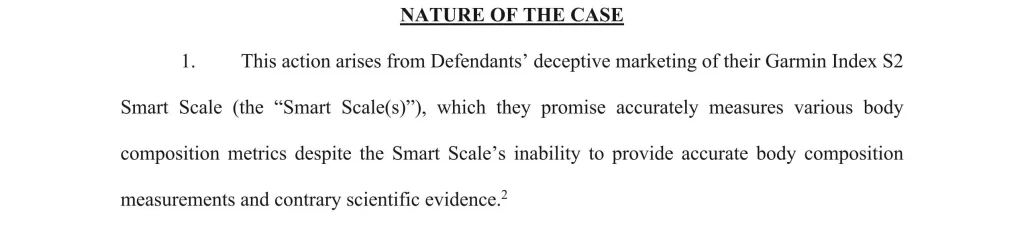
Maurer bought the scale in August 2024. When he compared the scale’s numbers to a DEXA scan—a highly accurate X-ray test used by doctors to measure body fat—he noticed major differences. He filed the 56-page lawsuit in an Illinois federal court, asking Garmin to change its advertising and pay financial compensation to affected buyers.
How the Technology Works (and Why It’s Limited)
The issue comes down to how these scales work. The Garmin Index S2 uses a method called “bioelectrical impedance analysis.” When you stand on the scale barefoot, it sends a tiny, safe electrical current up one leg, across your pelvis, and down the other leg. Because fat, muscle, and water resist electricity differently, the scale uses that resistance to estimate your body metrics.
Tech experts and scientists have known for a long time that this method has big flaws:
-
It only measures your lower body: because the electricity travels only through your legs, the scale mostly estimates your lower-body fat, not your total body fat.
-
People are shaped differently: Everyone holds fat and muscle in different places, which throws off the scale’s mathematical formulas.
While these scales can be useful for tracking weight trends over time, getting a truly accurate body fat reading from a two-foot scale is incredibly difficult.
The lawsuit argues that Garmin knows about these technical limits but still tells everyday consumers that the scale is highly accurate. A court will now have to decide whether Garmin’s marketing crossed the line into illegal deception.
Source: Pacermonitor


They are lying their customers for years. Sold a premium price for an Epix pro but everything else is mediocre and software is very bad and on top of everything they obsolete a 1000 euros device after 1.5 years. Pathetic
The case is legit – my body fat composition is 12-13%, accoding to my doctor and 2 other scales that include ‘handles’ to measure your body composition. I’m 174 lbs, very active, and lean. Yet Garmin s2 puts me at 24.8% fat content. Mine are being returned to Amazon today.
I have just bought these are my Garmin is telling me that my BF% is 37.5, that makes me dangerously obese. I have a BMI of 23.5, I weigh 10 stone and I am 5.5. I am certainly not obese and this data is really skewing my training plan as my watch has aged my by 5 years overnight.