

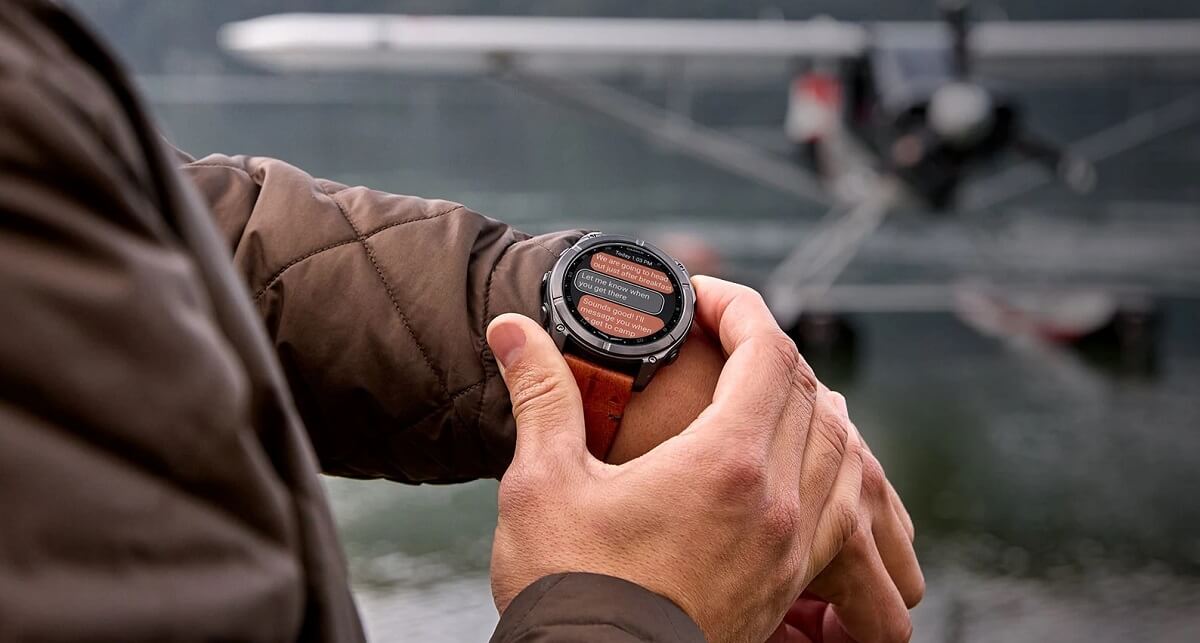
Garmin just pulled the curtain back on the D2 Mach 2 Pro, and it’s clear they are doubling down on a very specific vision for the future of aviation wearables. As someone who has followed the D2 evolution since the early days, this release feels like a pivotal moment—not because they’ve reinvented flight tools, but because they’ve finally addressed the “communication gap” for pilots.
Garmin D2 Mach 2 Pro: Complete Technical Specifications
| Category | Specification / Performance |
| Case Dimensions | 51 x 51 x 16.5 mm |
| Display | 1.4” AMOLED (454 x 454 pixels) |
| Lens & Bezel | Sapphire Crystal / Titanium |
| Communication | LTE (Voice/Data) & Satellite (inReach) |
| Connectivity | Wi-Fi, Bluetooth, ANT+ |
| Water Rating | 10 ATM |
| Storage | 32 GB |
| Smartwatch Mode | Up to 24 days (12 days always-on) |
| Battery Saver Mode | Up to 34 days |
| GPS Only | Up to 78 hours (56 hours always-on) |
| All Systems + Multi-band | Up to 53 hours (41 hours always-on) |
| Expedition GPS | Up to 24 days |
| Fly Activity (GPS + SpO2) | 59 hours |
| LTE LiveTrack | Up to 21 hours (Multi-band) |
| Max Battery GPS | Up to 123 hours |
Connectivity That Actually Matters in the Cockpit
The headline here is undeniably the addition of LTE and inReach satellite technology. To me, this is the biggest selling point. We’ve had airport databases and NEXRAD on our wrists for a while, but being able to send a two-way satellite message or initiate an SOS directly from the watch without fumbling for a phone or a handheld inReach is a massive safety upgrade.
Whether you’re flying over remote terrain or just want your family to see your LiveTrack progress without relying on shaky cellular signals, the D2 Mach 2 Pro turns the watch into a standalone survival tool.
The Physical Trade-off: Size vs. Power
If you’re considering this upgrade, you need to be prepared for the physical changes. Garmin didn’t just magic these new radios into the existing frame. The “Pro” is noticeably beefier, jumping to a 16.5 mm thickness compared to the 14.7 mm of the standard Mach 2.
In my opinion, the extra bulk is the price you pay for the peace of mind that comes with satellite connectivity. However, that extra hardware also eats into the battery life. In standard smartwatch mode, you’re looking at about 24 days—down from 26. It’s a small dip, but if you’re a pilot who hates charging your gear, it’s a detail you can’t ignore.
Familiar Flight Tools in a New Shell
Interestingly, Garmin didn’t introduce any new aviation-specific software features with this model. You’re still getting the gold-standard suite: the worldwide airport database, Red Shift mode for preserving night vision, and seamless flight plan syncing with Garmin Pilot.
While some might be disappointed that there aren’t new “flying” tricks, I actually appreciate that they kept the interface consistent. If you’re upgrading from the D2 Mach 1 or the standard Mach 2, the learning curve will be zero. You’re paying the $1,549.99 premium for the radio hardware, not a software overhaul.
Is It Worth the Premium?
At over $1,500, the D2 Mach 2 Pro is firmly in the “luxury tool” category. It mirrors the strategy we saw with the Fenix 8 Pro—adding LTE and satellite to a proven platform while keeping everything else the same.
Is it a must-buy? If you already have a D2 Mach 2 and you always fly with a dedicated inReach device, you might not feel the need to jump. But if you’re looking for the most capable, independent aviation watch ever made—and you don’t mind a slightly thicker case on your wrist—this is currently the peak of the mountain. It’s no longer just a flight computer; it’s a communication lifeline.
Also Read: Is the Garmin Fenix 9 Worth the Wait? My Deep Dive into the 2026 Rumors

