
Code recently found inside Garmin’s smartphone app has revealed fresh details about a potential new fitness tool: a dedicated Muscle Battery sensor.
First uncovered by the team at Gadgets & Wearables during an analysis of the Garmin Connect app (known as an APK teardown), the internal code shows specific lines designed to measure deep muscle metrics in real time.
What the App Code Shows
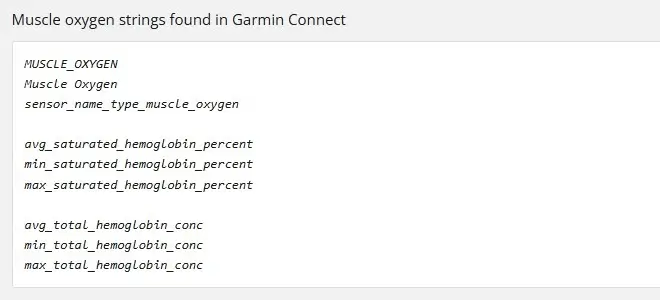
The uncovered code lists tracking fields for two main biological markers: saturated hemoglobin percentage (how much oxygen is in your muscle) and total hemoglobin concentration (the volume of blood inside the tissue).
For both markers, the app tracks three specific metrics:
-
Average levels: Overall muscle effort across your whole workout.
-
Minimum levels: The exact point where your muscle hits maximum depletion.
-
Maximum levels: Recovery peaks during rest sets, easier intervals, or post-workout cool-downs.
By recording both oxygen saturation and total blood flow continuously, the software can tell the difference between a muscle running low on oxygen and a general shift in blood volume.
Why standard smartwatches can’t do this
A regular optical heart rate sensor on your wrist cannot capture muscle-level oxygen data. Measuring this requires Near-Infrared Spectroscopy (NIRS)—a technique that shines specific wavelengths of light into tissue to read oxygenated and deoxygenated blood cells.
Because of this optical requirement, the feature points to a dedicated external sensor pod rather than a watch update. Athletes would likely strap the pod directly over the active muscle group:
-
Cyclists & Runners: Placed on the thigh (quadriceps) or calf.
-
Gym Lifters: Placed on the upper arm or legs depending on the exercise.
The standalone pod would gather the raw optical data and send it over to a Garmin watch or smartphone for real-time viewing and post-workout mapping.
Fitting into the Garmin Ecosystem
While third-party muscle oxygen sensors like the Moxy Monitor or the older Humon Hex have been around for years, they have always operated as external add-ons.
An official, native Garmin sensor would allow raw muscle fatigue data to feed directly into existing Garmin algorithms like Body Battery, Training Readiness, and recovery time recommendations.

